Showing posts with label 20s Cinema. Show all posts

Friday, January 4, 2013

Avante-Garde: Experimental Silent Cinema Of The 1920s and '30s - Written By Zach Frances

Are you into films that are a little on the weird side? Alright! What about films that are just downright ludicrous? Well, if you are, then Avante-Garde cinema is right for you!

I have selected a few of my favorites as recommendations. If you are well versed on the finer points of Avante-Garde and Surrealism in cinema, then my recommendations should provide some interesting insight. If you are a beginner, this can maybe point you in the right direction.

Starting off with an early favorite of mine:

Robert Florey and Slavko Vorkapich are responsible for this little ditty. If you are new to the Avante-Garde style, I would highly recommend that you watch this film first seeing as how the narrative is relatively easy to follow. Yes. This is one of those rare Avante-Garde films that actually follows a semi-coherent and surprisingly straight-forward story. Not only is 9413 moderately accessible, but it is really a brilliant piece of work.

9413 is an incredibly well done film, and a deeply personal experience on behalf of the spectator. The imagery and symbolism used in the film are not very hard concepts to grasp, making it a wonderful entry-point for those who are new to the cinematic style. It is a wonderful gateway into the world of the Avante-Garde.

Did you enjoy 9413? Ready for the next one? Well. Try Man Ray's 1929 wonderful little film titled THE MYSTERIES OF THE CHATEAU OF DICE.
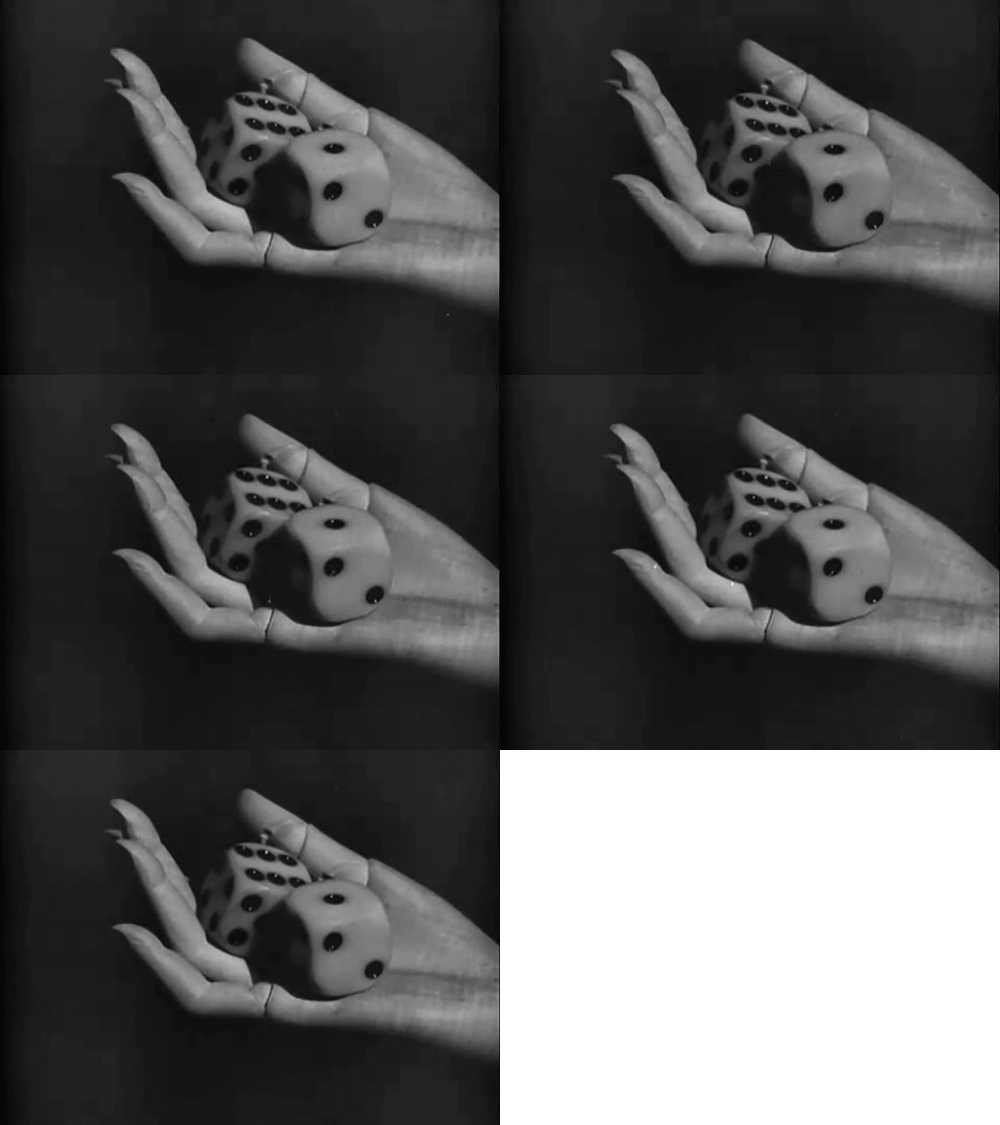
 The Chateau Of Dice is simply an incredible experience from beginning to end.  The film opens with a title card that reads: 'A Roll Of The Dice Will Never Abolish Chance', a sentiment that is repeated both visually and lyrically throughout the entirety of Man Ray's twenty minute expedition into the heart of phantoms. 

The Chateau Of Dice opens on a mannequin hand wielding a pair of dice. As if to symbolize humanity's wooden-hollow grasp on chance and assumes that fate considers all living things to be inanimate objects. We cannot stop fate. It is revealed that a faceless couple is rolling the dice in order to decide first if they will leave the house that day and secondly where. The dice answers the duo and they leave, driving out into the open and vast world. The camera work may seem to become less and less consistent on their lengthy drive, but this is all part of the point. The camera gets shakier and shakier the further the duo descend into the unkown. Meaning, our vision loses sight of itself once we alter our own path and seek out the unexpected. In fact the spectator is moving faster than the characters are seeing as how we arrive at the Chateau at least fifteen minutes before the characters ever do. 

Since the audience got there early, we look around at all the strange sculptures and the remarkably twisted architecture that make up the Chateau. We are reminded of a strange destiny that brought us here. One thing is wrong. After a while the spectator realizes he is all alone, and there is nothing he or she can do about it. We begin to ask ourselves questions like "Where Are We"? as our equilibrium descends into a spinning blur of confusion, occasionally fixing itself, but ultimately losing sight of the question. Day and night become interchangeable, the sun sets, the night leaves in an instant, we are still very much alone, and that's when we start to ask the right questions. 

We finally start to wonder whether or not phantoms exist. If a physical action done in the physical world, does it leave a trace of itself?

It's morning and the spectator has found a small group of people to latch onto. They are playing with large and seemingly fuzzy dice. These are people of the more playful variety. Playing with chance. It is also very important to note that unlike the earlier duo's faces which were completley void of personality and depth, this current group's faces are not completely souless. It is still hard to make out the finer points of their facial features, they are still faceless in a sense, but nearly as much as the earlier duo were. We are reminded by a title card about using dice to abolish chance. It never happens. 

The small group of people, two women and two men, go for a swim. The women keep their faces underwater so as not to reveal their true selves. A title card flashes that reads: 'Swim Cinema'. We are shown reflections of the pool on the wall overlooking it, the shadows of the characters are swimming, and the shadow-play demonstrates quite effortlessly the truth about what Man Ray was telling to tell us about phantoms. They do exist, all you have to do is look for them.

Once the group have finished with their dip in the pool they proceed to pose for the camera doing a handful of ridiculous things and wearing some ludicrous appartus that reminds us of a beauty salon. The character's faces progressively become more well-defined. What we can gather from this slow reveal of their faces is that the more physical traces we leave on this earth, the more our identities become clearer to the public eye. The more we do the more the world knows about us, the more fate and chance knows about us, and the more the spectators know about us.

The group gets understandably tired from having an exhausting day of leaving their mark on the intrinsic universe and go to sleep. All together they literally fade away into oblivion. Were they phantoms? Was this scenario a phantasm? The Chateau Of Dice holds many mysteries.

Finally, the duo from the beginning of the film catches up with their audience and arrives at the Chateau. They find a pair of dice in the grass, and give it a roll to see whether or not they shall remain there or not. The dice answer, they shall remain. They scale the roof and freeze like living statues. Or how Man Ray would like us to see them, they freeze in place like physical prints of themselves. Their essence remains. And that is all the world sees of us. It is also a clever observation on movie-going. When an audience sees a film, they are forced to believe that that the scenario in which they are watching play out is happening in real time right there in fron of them, when in actuality it is a the documentation of the physical remains of a group of creative pull participating in an activity. Well, aren't films real? Do they not have life? Are there not living and breathing emotions trapped inside each and every frame? I'm sure they are. With The Mysteries Of The Chateau Of Dice Man Ray asked us, 'Do Phantoms Exist'? And he taught me that not only do they exist, but everything I do in this world adds to the ongoing haunting that is human activity. A wonderful film, and one of my favorite pieces of Avante-Garde cinema.

Next we have the lovely 1928 splash by Hans Richter: GHOSTS BEFORE BREAKFAST
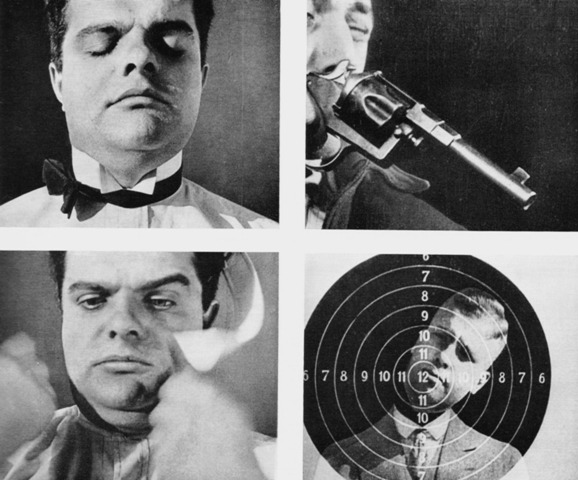
Ghosts Before Breakfast opens with a title card that reads: The Nazis Destroyed The Sound Version Of This Film as 'Degenerate Art'. It Shows That Even Objects Revolt Against Regimentation'. After that the films spits us out into 9 whole minutes of twisted symbolism, dazzling photography, and startling ideas. One of the very first images we see is that of young man putting on a bow tie. The bow tie rebels against him, refusing to be tied down. So much so, that the necktie actually unties itself and flies away from the young man, in a beautifully flowing sequence of stop-motion trick photography.

If Ghosts Before Breakfast is constant in one basic idea, its the idea of breaking free and splitting apart. Which is something all of the objects do, except for the objects that symbolize something violent. Violence is the only real thing that sticks with its own kind and never splits apart from its destined route. The imagery is downright overwhelming at times, but slows down for moments at a time to show us the same four hats avoiding capture from fervent young men aching to catch them. The hats, at this point, represent the idea of rebellion. You can never trap it, catch it, or stop it. Rebellion, like Violence, is an unstoppable force of nature.

The actions in the world of Ghosts Before Breakfast seems to be orchestrated by an omnipotent clock. You can't stop time. Time is the ruler of all. We shown a bulls eye being split apart, not by a bullet, but by the very lines that define it. When a  man's goal is blurred, his aim becomes twisted.

Then Breakfast is served, and those rebellious little bowler hats fly up to the table. A quartet of ghosts appear, the hats belong to them. The hats latch on to their masters, and their masters enjoy their breakfast.

I recommend Ghosts before Breakfast to all fans of the Avante-Garde, and at 9 minutes, it really isn't asking all that much of you, granted you are interested.

And the last film I have selected is a little known Surrealist gem from Orson Welles and William Vance called THE HEARTS OF AGE.
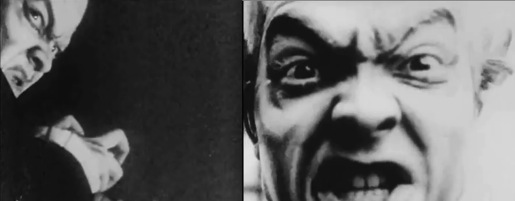
The Hearts Of age is an altogether wholly entertaining experience. As a viewer you're not sure whether what you are being shown are pf the visionary variety or if its all just a meaningless exercise on behalf of Orson Welles. The Hearts Of Age was made in 1934 when Welles was only nineteen years old, which makes The Hearts Of Age the debut film from the legendary Orson Welles. And it is quite a sight to behold.

The Hearts Of Age is a film I like to revisit every so often as it is truly an entertaining film. The images are loosely tied together, but are still set up in an otherwise coherent pattern. I find The Hearts Of Age to be a very important film in Welles' stunning catalog of directorial efforts. It is very interesting to see the man, the myth, the legend do something that is so far removed from what you would normally associate yourself. If nothing else, The Hearts Of Age is a refreshing and joyful experience, and another notable film from the cinema of the Avante-Garde.

Well then.

I hope you enjoy some of the films I have selected. Avante-Garde is an acquired taste, it is a whole new language of film, and at first it can be very difficult to decipher and communicate with. But once you do, you will be granted access to some of the most interesting and enduring films ever made. Once again, I hope you enjoy these films and thanks for reading.

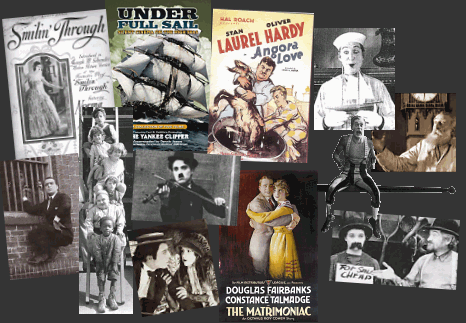
Zach's Favorite Films Of The Silent Era!

It is time for a very special post. CineThreatOnline will be discussing their favorite films of the Silent Era in an upcoming video, but for now Zach Frances will write about some of his personal all-time favorites.

Starting with Number One:

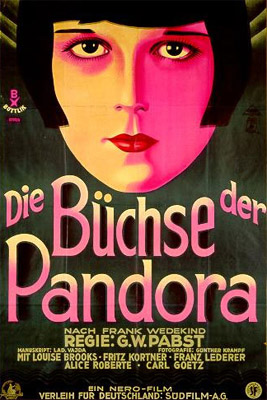
Pandora's Box is unquestionably my favorite film ever made. Nothing else even comes close. I have written before for CineThreatOnline about this 1929 masterwork from the great G.W. Pabst, and I stand by my sentiments entirely.

Pandora's Box is one of those mystifying and enigmatic pictures. A monumental artistic achievement, and the Silent Era's last gasp of life. Pandora's Box is a character study of everyone in the film with the exception of it's main character Lulu. As a spectator, you are not supposed to wonder why Lulu does the things she does, but you are supposed to be greatly affected by them. Just like the other characters in the film, you are both obsessed and repulsed by what Louise Brooks as Lulu makes you feel. She makes you feel woozy, confused, and lost. She makes you fall in love. And she makes you bleed because of it.

No one could create Louise Brooks, just like no one could create Pabst's 'Lulu'. No. Pabst's 'Lulu' had to be real, had to exist, and had to do so naturally; unaware. No. Louise Brooks is not a Pabst invention, and neither is her performance in Pandora's Box. What Pabst did, quite simply, was find his 'Lulu'. The film itself is pure invention, Pabst used psychology as his weapon and his intellect as his charm. He pinned actors against each other, he favored one actor on Monday only to dismiss him by Tuesday. Pabst created the purest form of realism possible. By exposing his actor's insecurities, hiding the plot from them, and initiating mind games with every member of the cast on and off set. Pabst loved chess. His love of chess is evident in Pandora's Box. Pandora's Box is his 'check-mate'.

So. No. Pabst did not create Lousie Brooks. Pabst made Lousie Brooks what she is today; an ultimately tragic relic of a bygone age. I cannot believe how astonishingly perfect Pandora's Box was conceived. Pabst is a true nobleman of the cinema for a number of reasons, my confidence will never sway in that regard. Pabst made the perfect film. A rarity, a pleasure, and a true art. His direction, the key to the enigma, only comes out of its perpetual hiding after a few viewings. It is Louise Brooks, and only Louise Brooks, that your eyes and heart feast on during the first time you watch Pandora's Box. Brooks was the most enchanting, dazzling, and transcendental of the silent screen goddesses. In the scene where Shon is caught making love to her by his fiancé and his son, Brooks delivers the greatest facial expression ever captured on film. An act of dominance and sexual achievement. A grin that is truly timeless, as if she's staring through time and space, testing your wildest urges, daring you to love her, and begging you to beg to forget it. Although Brooks didn't know then, or even cared to know at the time, soon she would have Pabst all figured out. She realized that the greatest performance of her career, and one of the most legendary in all of cinema, was not a performance at all, it wasn't even acting. It was her. It was documentary. I was real.

Perhaps the greatest invention belonging to G. W. Pabst was the invention of truth. Things look different when they are being filmed, it is a natural reaction to put on on an act of sort when one knows he or she is being watched. Pabst bypassed that fault in cinematic realism and created reality. Untouched by fabled hands, pure and innocent, L. Brooks. Arguably, Pabst is the only director who has ever accomplished such a remarkable feat.

Number Two:


If you want to be startled by a motion picture, if you want to be haunted by a performance, if you want to be humbled by sincerity -- Carl Theodor Dreyer's 1928 tale of The Passion Of Joan Of Arc is for you. What Dreyer accomplishes here is all thanks to his star, Maria Falconetti. Never has a role been executed to such an empathetic extent as Falconetti demonstrates here. You feel for her, more importantly, you feel her.

The Passion Of Joan Of Arc is haunting but it is never morbid nor is it depressing. In fact it is a lush example of filmmaking at its best, a director at his peak, and an actress in the role of a lifetime. The best scene Godard ever filmed was set in a movie theater. Godard filmed his actress, Anna Karina, watching The Passion of Joan Of Arc and becoming so deeply affected by it that she starts to weep. I weep almost every time I see Maria Falconetti. NO. Strike that. I weep almost every time Maria Falconetti sees me.

I always love the watching the early sound pictures from the great silent era directors. Another one of Dreyer's best work, in my opinion, was Vampyr, and the language the film tells itself in is purely of the silent era. While sound does exist in Vampyr, the images take center stage. Sound almost reveals itself as a cursed and wretched presence in the film. Vampyr is my favorite vampire tale ever filmed. Step aside, Nosferatu! And Vampyr is like the blurred and wounded brother to it's sisterly counterpart, The Passion Of Joan Of Arc. Together both Vampyr and The Passion Of Joan Of Arc tell a great deal about the soul of the man who made them. Both represent two very different sides to the man, yet viewed back to back provide both a coherent personality and a sympathetic heart. Carl Theodor Dreyer was the heart of early cinema. Dreyer was the master of light. His films are so powerful that they are literally stunning.

Number Three:


Conrad Veidt should be a household name the way Chaplin, Garbo, and Fairbanks are household names. In The Man Who Laughs Veidt plays Gwynplaine, a victim of a horrific act of torture and wickedness. He is the man with a permanent smile, disfigured as a child because he was the unfortunate son of a unwise father.  As the title card states, the King condemned him "to laugh forever at his fool of a father."

Regarded as the most sparkling jewel of Universal Studios' silent canon, The Man Who Laughs was directed by the great Paul Leni, a key figure in German Expressionist cinema, and it is directed with the grace of a master. Leni tells it like a tragedy. Leni makes you never want to smile again, not unless you really mean it. As much as I like directors like Lang and Dreyer, I feel that most of their most interesting and emotional work came after addition of sound, whereas as filmmakers like Pabst, Leni, and Murnau were true silent film virtuosos who understood the language in which the era communicated itself better than most and never quite made a film in the sound era as monumental as their silent masterworks. Some didn't live to see the light of sound. Leni never made a sound picture. Which is shame. Leni was an incredible master of film, what he would have done with the sound technology is unimaginable. His final film, The Last Warning, is telling of a director aching to get his hands dirty. Paul Leni does not usually receive proper acclaim for his contributions to early cinema. Those reservations are usually reserved for those who went on to make interesting sound pictures, like Lang or Dreyer. It's unfair. Leni is a goddamn pillar of the Silent Era, without the films of Paul Leni German Expressionism never would have matured into a coherent platform for displaying real human emotion. The Man Who Laughs is the most mature and adult film in the Expressionist canon. It is also one of the best.

Conrad Veidt is a marvel in the film. He was born to play Gwynplaine the Smiling Clown, and I believe I was born to watch to him play it. But alas, Veidt was not Universal Mogul Carl Laemmle's first choice. Originally Lon Chaney was locked for the role, but wasn't too wowed my the material and bowed out. Lon Chaney made a splash in 1923 with another Victor Hugo screen adaptation, The Hunchback Of Notre Dame, and Chaney felt the material was far too similar for his liking. Nothing against the man of a thousand faces, but thank heavens Chaney dropped the ball! Veidt delivers one of the most harrowing and affecting performances ever seen. He is both horrifying and pitiful, a monster and a victim, a smile and a gasp. It is commonly known that Bob Kane drew inspiration for the legendary comic book villain the Joker from Veidt's appearance in the film. But I think he also took some of Veidt's manic hysteria with him as well. When you watch him on stage, you forget you're watching a movie altogether. Suddenly... suddenly you're watching an artist.

Number Four:

And make that two points for Conrad Veidt as we add another wonderful piece of German Expressionism on to the list! Actually, Robert Weine's 1920 film The Cabinet Of Dr. Caligari is the expressionist film. Upon it's initial release the film was called vulgar, juvenile, and disgusting. Well, I have some good news for you... it still is!  

The Cabinet Of Dr. Caligari has an attitude problem. The film wants nothing more than to punch you right in the face. Visually extraordinary, stylistically legendary, and thematically revolutionary, The Cabinet Of Dr. Caligari is one of the best and one of the very first horror films ever produced. And the film is psychologically insane. Modern storytelling isn't nearly this good.

Robert Weine was an interesting figure in the history of film. Though he would never make something as triumphant as The Cabinet Of Dr. Caligari ever again, he would still have moments of genius periodically throughout his later career. Most notably with The Hands Of Orlac in 1924, another picture starring Conrad Veidt, and though it is incredibly slow paced, The Hands Of Orlac is ultimately satisfying and rewarding. But it's The Cabinet Of Dr. Caligari that I am here to appreciate. It is the performances of Werner Krauss and Conrad Veidt that I am here to remember and happily lull.

Visually, The Cabinet Of Dr. Caligari might be the most influential film ever made. I honestly doubt whether German Expressionism would have hit the western world the way that it did had it not been for Caligari. Metropolis certainly wouldn't have existed, Film Noir would not have developed in quite the same way, and modern filmmakers like Tim Burton and Guillermo Del Toro would be visionaries without a vision had it not been for Caligari.

It is an incredible film, and I highly recommend it. Modern psych-thrillers don't even come close to matching Caligari's complex and completely absorbing tale of murder, insanity, and possession. The dynamic of substance and style are equally matched throughout the film. Cheers, Weine, for a film that will live forever!

Number Five:

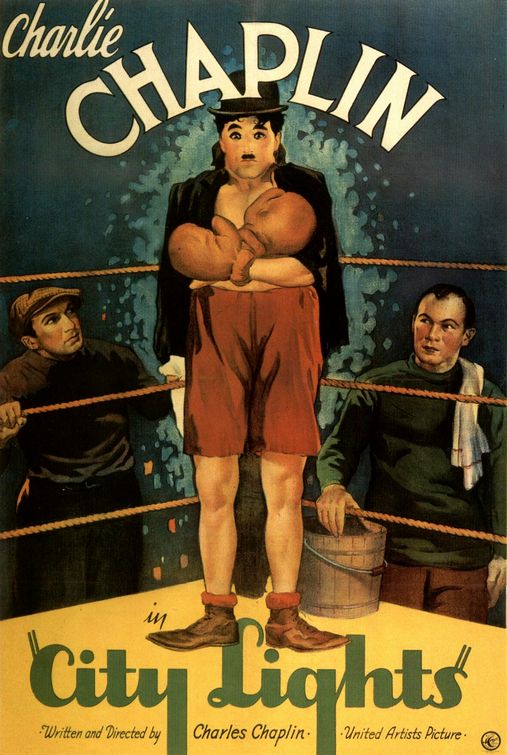
1931. City Lights. Chaplin's best work. Made during the heyday of talkies, City Lights is rebellious and courageous. It is the most heartfelt thing Chaplin ever produced. He proved that sound was not an improvement over silent films, but rather hindered the evolution of visual storytelling. He took what was already being called a dead technology and made something beautiful and extremely heartfelt with it. Words cannot describe the glory of City Lights, and that's something Chaplin wanted to make perfectly clear.

If only Silent Films had never died, and simply became a separate entity from Talkies, Film would have so much more beauty and love to them. What silent films accomplished in its short lifespan is more than modern filmmaking has done in almost one hundred years. Silent films evolved so far in such a short time that it's a crime against art that Talkies had to come along and tarnish such a fine legacy. Talkies haven't evolved worth a shit. In fact, if you follow the so-called evolution of the Talkie, you'll find that it's not an evolution at all, it's a downward progression, a devolution, and a fucking disgrace. The Silent Era is the one true era of cinema, it is Cinema unfiltered, it is Cinema 100 proof. It is my all-time favorite era of film, and it is a wonderful place to visit.


Be on the look-out for CineThreatOnline's web video where Zach Frances and a panel of film fanatics will be discussing Zach's favorite silent films, as well as the much-loved The Artist. Is The Artist a return to silent film, a love letter, or just an Academy Award Winning gimmick? Keep an eye out for the web video to see what CineThreatOnline thinks about it.