Showing posts with label 60s Cinema. Show all posts

Saturday, January 19, 2013

To Catch A Thunderball or: Fiona's Apple - Written By Zach Frances

Fiona Volpe: Do you like wild things, Mr. Bond, James Bond?

James Bond: Wild? You should be locked in a cage.

Fiona Volpe: This bed feels like a cage. All these bars. Do you think I'll be safe?


Sean Connery's fourth outing as James Bond is also one of his very best. It is called Thunderball, and there is a very surprising theme underlying the film: prisons and prisoners. It may be the most complex Bond movie ever made.

The first time Bond sees the word 'Thunderball' it is stamped on the cover of a top secret folder, its contents confined by both confidentiality and sealed by tape. He is told to examine the documents contained within the Thunderball folder after hearing that his government is being forced to pay a large ransom to protect its citizens from nuclear catastrophe. Therefore his Government has been turned into a prison of SPECTRE, its citizens turned prisoners. There is also the matter of the missing plane that had carried the atomic bombs, its missing. Where does Bond find it? Confined underwater in a shark cage.

"Vanity has its dangers."
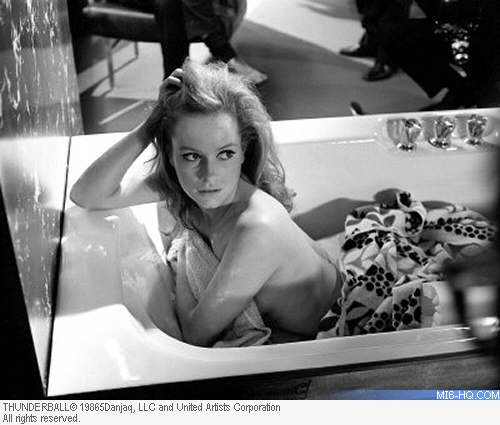
Several characters perpetuate the theme of prisons and prisoners further, but none so much as femme fatale Fiona Volpe. She completely fascinates me. Possibly my favorite Bond girl of them all, Fiona Volpe was portrayed by Luciana Paluzzi in the film with deadly precision. She is an agent of SPECTRE and an absolute scene-stealer. There are many fascinating things about Fiona, but first off I would like to talk about her appearance. She is a very desirable woman, sometimes she is too beautiful for words, and evil is one of her most attractive qualities. This makes the viewer a prisoner of his own attraction to danger and evil, but that's far too simple a statement to make when dealing with a Bond film. Her villainy highlighted by her physical beauty reveals deadly desire's true colors: passionate and "wild". Bond's relationship with Domino, the true Bond girl of the film, is of the traditional variety, meaning hollow and acceptable. Bond and Fiona, on the other hand, pursue a short but passionate and revealing affair. This proposes the concept that being evil is more emotionally rewarding than being good. Or at least a more passionate alternative to it. Her appearance perpetuates this concept further, since she is a very beautiful woman, much more so than Domino, one can assume that evil is more beautiful than good. While Emilio Largo has Domino followed constantly so as there is nothing to damage her innocence, Fiona is independent as well as damaged, and about as far from innocent as you can get. Bond's desire leads him to Fiona, but its his mission that makes Domino the necessary companion. Then again it is Fiona's mission that leads her to Bond, but you must understand, her mission was her desire. When men think with their hearts, evil's sway is well in reach, but when they think of their duty, rewards for this obedience will come with practicality.

In fact one of the major gripes Bond had with Fiona was the fact that she wasn't affected emotionally by sleeping with him. Perhaps even the fact that Bond was seduced instead of the other way around. Both characters are prisoners of sex and duty. The only time the two of them actually participate in romantic affairs is when the mission calls for or allows it to take place. Fiona tells Bond that the bed they are making love in feels like a cage after Bond tells her she belongs in one. In this situation, the mission is the prison, and Fiona and Bond's allegiance to their organizations is something they both know will prevent them from ever seeking true comfort in the arms of another. Fiona and Bond mix sex with violence so much I'd be surprised if either one can tell the difference between the two. Maybe there's no difference at all.

Fiona expresses how wild she feels, while earlier Bond expressed to Largo how he is not a man of passion. This contrast should prove an important one while on the topic of sex in Thunderball. Before Bond has his affair with Fiona, we see him engage in intercourse with a physiotherapist and it is neither passionate nor involving, its borderline bribery and boredom. With Fiona, it was very different, and the difference was made abundantly clear by Bond's actions after Fiona turns on him. Laying with evil made Bond feel something we had never seen before Thunderball, it made him feel passion. The question of whether or not Bond knew Fiona's intentions the whole time is wholly insignificant here because that's not the way Sean Connery played that scene. Sean Connery played a hurt Bond, but only as hurt as James Bond can get. Its a performance of nuance and subtlety, even if he knew in his heart of hearts that Fiona was an agent of SPECTRE, he was enjoying her company rather than absorbing it. He allowed himself to be physically and emotionally probed rather than physically dominate her. And then he learns that wasn't even a possibility. Also, the fact that the ring she wears gave her away is telling of the marital allegiances SPECTRE agents hold. There is absolutely nothing that gives away Bond's affiliation with the British government, but perhaps that's because they don't brand their agents. Interesting that its a ring though, considering the marital implications derived from such an accessory.

Fiona's apple, her passion, gave way to her death.


The death of Fiona Volpe is my all-time favorite death in any Bond film. The set-up is deliriously exciting and the whole scene washes over you in masterstrokes of editing. Its also my favorite death in any Bond film because of the underlying ideas that accompany it. She dies performing a passionate activity, dancing. A gunman has Bond in the cross hairs, Fiona knows this and Bond knows this. The gunman fires, and Bond swings Fiona around in order for her to catch the bullet. The bullet enters her spine, presumably lodging itself in her heart. Bond covers the bullet's entry-point with his hand and briefly continues to dance. This is a perfect visual metaphor for passion in the modern industrial age. Man can have his passions just as man can play with fire. But when duty calls, it is man's responsibility to heed it. Man must cover up his passions in order to fulfill his obligations to society. Man does not necessarily need to be devoid of emotion, but he cannot be ruled by it. Fiona had to die in order for Bond's world to continue unaffected by her cold resolve. Much like how Fiona's loyalty had not been swayed by sleeping with Bond and sharing one of the most private things you can share with a person, Bond was wholly unscathed by watching her die. Sex and dying are two very personal things, and they are things Fiona, a self-described wild woman, shared with 007, a self-described man of little passion.

Allow me to praise Luciana Paluzzi for a moment because I thought she was just extraordinary. Her physical beauty alone communicated the passion, honor, and maleficence the dialog likes to take credit for. The dialog did not communicate those feelings, it inherited them. Paluzzi communicates feelings that are not in the script, and her character feels the most alive out of all of them. She really did steal the show here, and like Mercutio and Moritz before her, her character was the crux of the production, regardless of her lifeline. She personified beauty and evil, and how the two can't inhabit the same body without warring with each other or causing some sort of self-fulfilling doom. One of the better performances by an Actress in a Bond film. Whether you agree or disagree, you do remember Fiona Volpe. A superb villain, very underrated, but incredibly iconic.

If I could just touch upon the similarities with James Bond and Emilio Largo for just moment, and say that like most of his other villains, they share several likenesses. Only in Thunderball the similarites are more evident, seeing how Largo is SPECTRE's Number Two, and, arguably, Bond is the British Intelligence Agency's go-to man. Neither man seems to trust their women, and neither of them should. They share an affectation for duty and honor, and an unbreakable bond with the organizations that have fostered them. It might also be worth pointing out that Largo defeated Bond in combat, and Bond's life was saved by Domino, a woman Largo once trusted. I find it interesting that Largo physically defeated Bond, almost as if his allegiances to duty were of the passionate kind, whereas Bond seems to go through the motions in a textbook style more than define them heroically, altruistically, or passionately.

There is so much more I can talk about concerning Thunderball, but I feel that this article has gone on long enough. This is one of my favorite Bond films, and I think technically speaking, it may be the best of the Connery era. A lot of people seem to gloss over the characters in Thunderball and I enjoyed taking this time to single out a few interesting points about them. Like I said in my Dr. No article, a lot of people fail to consider Bond's underlying themes, but if you do the films become much more interesting. Thunderball is high up there on my list of favorites and I hope you enjoy it as much as I do.

Thanks for reading!

-Zach Frances

Thursday, January 17, 2013

The Humiliation At Crab Key Island or: A Dr. No You Can Touch - Written By Zach Frances

Dr. No: I'm a member of SPECTRE
James Bond
: SPECTRE?

Dr. No
: SPECTRE. Special Executive for Counter Intelligence, Terrorism, Revenge, Extortion. The four great cornerstones of power headed by the greatest brains in the world.

James Bond
: Correction. Criminal brains.

Dr. No
: The successful criminal brain is always superior. It has to be.


Seniority has nothing to do with it, Dr. No is one of the best Bond movies ever. Much is written about the James Bond series, but not much is actually said. The fans of James Bond fit into what I like to call a bandwagon following, meaning that they go with the popular trend of the character. Goldfinger used to be heralded as the best Bond film ever made. Period. Then Skyfall came out and the critics praised it. Suddenly the fans learned a different tune. Me? Never. Dr. No was one of the best when I was five years old and its still one of the best today. The titular character is the reason why.

"East, West, just points of the compass, each as stupid as the other."
Dr. Julius No does not appear until nearly two hours into the film, and by then he is more than an enigma, he's a goddamn ghost, and that's exactly the way actor Joseph Wiseman plays him. The name 'Dr. No' is ushered repeatedly throughout the film. Almost religiously. Truths, lies, and mysteries are all spun before the crux of the film makes his entrance. The film defines Dr. No by what people say about him, rather than what he actually does, by mysteries rather than facts, by his absence and not his presence. Dr. Julius No is defined by the dangerous measures the hero goes through in order to face him and not the actual confrontation that expels him. As it happens, Dr. Julius No is the most fleshed out and fully realized character of the film, regardless of having such a small amount of screen-time. He is an unseen and hauntingly sinister shadow, a nightmare, a mad man, a God, and then he appears... and Joseph Wiseman does not disappoint.

"Unfortunately I misjudged you, you are just a stupid police man..."
The scene where Bond comes face to face with No and joins him for dinner is, bar-none, the greatest scene of its kind. Ever. In any film. The way Wiseman approached his character was flawless, understated, and unsung. To say he was emotionless would be insulting, he oozes insecurity. A man who has awaited defeat since childhood, No had been dealt one embarrassment after another in a series of painful blows throughout his lifetime, and he has welcomed every one of them with his... hands open. He's fashioned himself a God but never defines the purpose of his Kingdom nor does he particularly identify himself with it. He speaks loathsomely of those who have rejected him his entire life, of the humiliation he suffered that repels him from being accepted, and  the jealousy and sadness that all of that humiliation creates. Sadness can be mistaken for emotionless very easily, which is a mistake most people make when they watch Dr. No.

Make no mistake of it, No is a tragic character. He sits with Bond, both orphans, both unwanted, both are being used by a secretive organization for their own devices, and yet only one of them is ruined because of it. Dr. No offers his companionship to Bond and Bond laughs in his face. Bond humiliates him. Just one more person in a long line of people who have rejected No and have laughed in his face. Just another humiliation.

Dr. No's final humiliation is death. He fights knowing he cannot win, he never wins, and he doesn't deserve to. His own master plan betrays him, his Kingdom consumes him, and, ultimately, he suffers the greatest humiliation of all: fighting for your life and failing to save it. No was a wonderful villain, and the best villain ever crafted for a motion picture. Most people think that since its a Bond film, there isn't anything lurking between the lines. I assure you that these people are being foolish. When you look at Dr. No, at the way he carries himself and if you actually listen to what it is he says, a portrait of an unloved, heartbroken, and vicious man appears before you. Whether you choose to recognize his dilemma is a decision entirely of your own choosing. You just can't ignore the humanity of Dr. No. It is impossible for me to accept the final confrontation as anything other than it truly is: humiliation. I'm not saying No did not deserve death, just the opposite. What I am saying is far more important: No deserves to be viewed as the villain he really is. No is complex, multi-layered, and tragic. Dr. No is an enigma.

There are several other reasons as to why Dr. No is my favorite Bond of them all, but none of them are as important as exploring its titular character. Well... maybe this deserves some attention:

Smoldering hot.

There you have it. One of my favorite Bond films of all time, and one of my favorite movies ever made. A strong sense of nostalgia accompanies this film when I watch it. A strong sense of nostalgia and an overwhelming feeling of adventure. I am a huge Bond fan and this is the first of many essays I plan to write about the series. I saw it fitting that the first essay I wrote was about the first installment in the franchise. Thanks for reading.

-Zach Frances


Saturday, January 5, 2013

Four In The Wave - Written By Zach Frances

For this ongoing CineThreatOnline series I will be selecting films from four of the most influential filmmakers of all time: Michelangelo Antonioni, Federico Fellini, Francois Truffaut, and Jean-Luc Godard. All four of these legendary filmmakers emerged in the 1950s and '60s as part of two separate but equally revolutionary movements: The Italian and The French New Wave. They are some of the most incredible filmmakers of all time, and their films are not only consistently thought-provoking but occasionally downright genius works of art.

The Filmmakers: Michelangelo Antonioni, Federico Fellini, Francois Truffaut, Jean-Luc Godard.
The Films: L'Avventura, 8½, The 400 Blows, Vivre Sa Vie

First. The Italians:

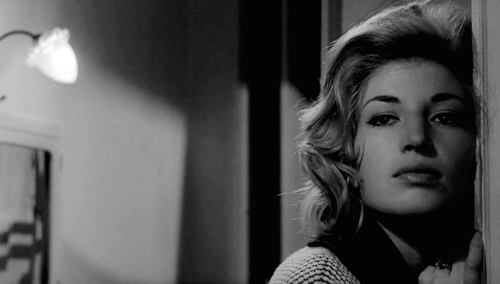
Michelangelo Antonioni is a polarizing figure in the film community. You either love him or you hate him. Me? I absolutely love his films! L'Avventura is one of most enigmatic films I have ever seen. L'Avventura tells the story of the disappearance of a young woman and how (if) it affects the other characters in the film. The film stars Monica Vitti and Gabriele Ferzetti as the only two people with any conviction as to actually find out what happened to her. Along the way, even they lose interest with their missing friend, and become much more interested in each other. The fate of the missing girl is hardly a misnomer. The film is wonderfully acted and the script is so good it can cause a delirious side-effect of awesomeness. Most impressive is how L'Avventura looks, and the thing looks gorgeous, possibly the best camera work done in an Antonioni film. And the people are beautiful! Honestly, take a gander at Monica Vitti:

Monica Vitti is one of the most beautiful women ever photographed. You honestly can't your eyes off of her. In contrast to her stunning appearance, the character she portrays is soulless. Empty. Then you start to realize that's the point of it all. Everything looks beautiful in L'Avventura, but it's all empty. From the characters to the very world they inhabit, its all a heartless vacuum of emptiness. But God, it looks unbelievable. The emptier you are, the more beautiful you become. Antonioni communicates a great deal here about humanity. About vanity. About waste.

The acting is very impressive. Monica Vitti turns in the best performance of her film career, as does Gabriele Ferzetti. Another top-notch performance is given by Lea Massari as the woman who goes missing. In her brief amount of screen time she lays down a mesmerizing performance. She plays her character as displaced, jaded, and finally waking up to the world around her. To the emotions she is actually feeling. She is not as empty as the rest, its almost as if she can recognize the emptiness in her soul and it makes her sad. So when she finally does go missing, the audience really has no clue what actually happened to her. Massari plays the part so well that the cause of the disappearance could be wide variety of things. An accident? A murder? Did she kill herself? Did she run away? Her performance is so eerie that it haunts the rest of the film. Vitti's character treats her as you would a phantom, and so do we. Did she even exist? Did she actually exist at all? Lea Massari is the phantom, but Monica Vitti is the enigma. Why is she so mysterious? Why is she so damn alluring? Monica Vitti is an intoxicating force to be reckoned with here, and by the end of the film, you still never really got to know her. Because truthfully she isn't anyone. She is a ghost that's afraid of scaring herself. She is the ghost of a good thing. The most visually stunning haunt in the entire cinematic universe.

I actually always looked at L'Avventura as the Arthouse's most intelligent and legitimately scary ghost story. I always viewed the characters not so much as actual people, but as impressions of living things. A practical joke on behalf of the living. Monica Vitti seems to be the only one who isn't in on the joke, as she struggles with losing her humanity. But alas, she is so beautiful she is unreal, she is ghostly, something so perfect she must be an apparition. A mirage. An imitation of life. And the film never judges its specimens. Not once does Antonioni pass any judgement on the characters whatsoever. You see what you want to see.

L'Avventura is also an Antonioni anti-mystery. The film sets you up for it, you think you recognize the give-away thematic elements, and then it takes you somewhere else entirely whilst the mystery takes a back seat. This would not be the last time Antonioni would take Hitchcockian themes and dissect them. He was known for turning film on its head. He was always exploring the boundaries of film, and he enjoyed it. He was an artist first and foremost, and L'Avventura was his Mona Lisa.


L'Avventura is one of the great treasures of the cinema. One of my all-time favorite films ever made, and one of the most mysterious films in my collection. I am awe-struck by Antonioni's vision, startled by it really. I am taken aback, my heart leaps out of my chest at such a beautiful sight when such an empty truth is underlying all notions of attraction. Attraction can be such an empty feeling. It's only when forced to live with said-attraction, that empty emotion, that it starts to haunt you.


Moving On To The Next Selection:

I'm going to be honest. As a movie-goer Fellini has always been a tough pill for me to swallow. He is one of the most self indulgent filmmakers ever to exist, and his films lose sight of themselves all too often for my liking. But 8½ is a different story. 8½ is a remarkable odyssey into the sordid mind of a filmmaker. It is the best movie ever made about making movies. Its Fellini's greatest achievement as a director, as an artist, and as a visionary. 8½ earns Fellini his legendary status. This might just be the most influential film I have selected for this segment. I highly enjoy 8½ and it is one of the few films by Fellini I can honestly say I have enjoyed fully from beginning to end. This is definitely one of the more daring films ever produced, surely one of the more honest jewels in the Arthouse, and if you haven't seen this debonaire classic for yourself.... you just haven't actually watched a film yet.

Next Up, We Have The French:

Francois Truffaut's The 400 Blows. The best coming-of-age story ever told. The most deeply moving experience I have ever had with a piece of 50s cinema. Partly auto-biographical, this was Truffaut's feature debut, and it was the best debut from a director since Orson Welles with Citizen Kane. Truffaut actually scheduled the shoot so that he would be the same age Welles was when he made Citizen Kane. Coincidence? I think not. Both films transcend the medium.

Words really can't do this film justice. If you've seen the film, then you can understand why I've selected it. The most moving motion picture of the 50s, directed by a natural born master of the medium. Essential viewing for all film fans.

Last But Certainly Not Least:
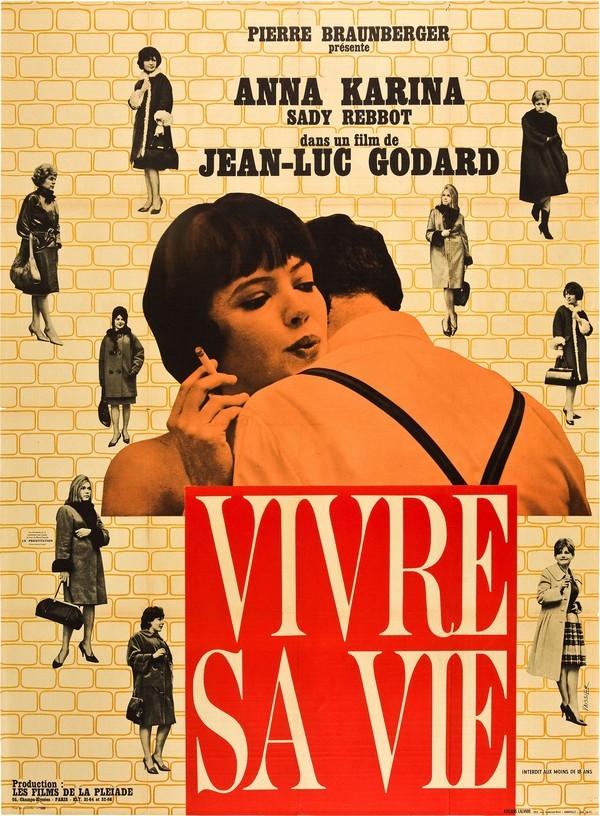
Whenever I'm asked what my favorite Godard film is, I always receive funny looks when I tell them Vivre Sa Vie. I know it's not as energetic as his earlier films like Breathless and Band Of Outsiders, but it is one of the only truly touching films Godard ever made. Watching Vivre Sa Vie is like a cinematic awakening. This film has a lot of heart. Nothing about the soul of the film is staged in any way, the soul of the film is defined by its own constantly evolving personality which makes the emotional toll of watching Vivre Sa Vie wholly organic and very real. Its as if we are watching a film being born out of an idea, we watch the film have fun with its new found life, and  we watch how it all ends. A clever metaphor for the life creative people give to inanimate objects, and for the passion that is ultimately lost on them. Godard never tries to force this one on you. Godard has split the film into twelve different tableaux in order to tell his story, a device that has been borrowed and used time and time again. The most important thing about Vivre Sa Vie is that Anna Karina's best performance can be found here as a prostitute in 1960s France. Karina is astonishing in Vivre Sa Vie. Physically and emotionally, she is a godsend.

Her eyes give everything away.

 Rather than go over the entire film and all of the ideas and statements Godard makes with it, which would take forever, I'll simply talk about one scene in particular that has since been branded into my heart.

It takes place in a movie theater. Anna Karina is watching Carl Theodor Dreyer's silent masterpiece The Passion Of Joan Of Arc, and begins to weep. We watch as she connects deeply with a film, and we in turn are affected by it as we are reminded of how moving a great film can really be. The entire sequence is breathtaking. One of the most touching things Godard ever filmed. This isn't to say that Godard is not a heartfelt filmmaker, there are personal moments in most of Godard's films, but sometimes he strives more of an artist than a human filmmaker. Here, in Vivre Sa Vie, the soul of the filmmaker can be found in all of its compounding sentimentality.

This scene means so much to me because never has the act of investing yourself emotionally in a film been explored to such a startling result. Anna Karina watches the film in tears, and she looks incredibly pretty and innocent. Watching films can be a beautiful experience. Vivre Sa Vie demonstrates that wonderfully.

Next Time In Four In The Wave: L'eclisse, Fellini Satyricon, Jules And Jim, Breathless


Friday, January 4, 2013

Rosemary's Baby (1968) - Written By Zach Frances


Rosemary's Baby is my favorite horror film of all time. Its got it all: a genius director, marvelous actors, a haunting tale, spooky neighbors, dastardly witches, and, of course, Satan. The film revolves around a young woman named Rosemary Woodhouse. Rosemary and her husband are expecting a child. But Rosemary doesn't look so good. Rosemary is starting to believe that she has been impregnated by evil itself, and everyone she knows might be in on it. As a thriller it works on a level Hitchcock only hinted at. Its a film that surpasses masterpiece and classic, and rests snug atop the terrain of legend.

It was once a venial sin to watch this film, condemned by the Catholic Church and the Legion Of Decency, now you can own it in glorious High-Definition, with a genial satisfaction only Criterion could bestow!

Rosemary's Baby only gets creepier with time. There are several different ways to view this amazing film. And this film, in turn, tries to tell us many several different things. As film scholar David J. Skal points out in his fantastic book 'The Monster Show':


"Whether Levin's strategy was conscious or not, the plot of Rosemary's Baby was a brilliant metaphorical distillation of the widespread ambivalence and anxiety over sex and reproduction, concerns overshadowed by the garish glare of the swinging sixties. On a simplistic level, both Rosemary and the reader share lingering doubts about the chemical-occult tinkering of their reproductive systems. Rosemary drinks the stinking tannis-root cocktail that her neighbor provides while the reader(likely) swallows the magic candy of birth-control pills. Neither has a deep understanding of the effects of either substance on their bodies and their lives; they rely trustingly on patriarchal authority. Rosemary Woodhouse is led repeatedly to believe she is making her own carefully considered reproductive choices, but the decisions are all being made for her. No matter what assurances are offered, no matter what charms and preparations she uses or ingests, she is not really safe. One of the many indelible images in the film version of Rosemary's Baby is the pregnant but wasted-looking Mia Farrow dashing out against the light into midtown traffic, an apt metaphor for child-bearing under socio-technological seige."

Roman Polanski is my favorite living Director. He is without a doubt the most cathartic of any, living or dead, and damn near the most personal. To think that just one year after making Rosemary's Baby, tragedy would strike his home, wife, and child, is far too horrifying a concept to accept as reality. Polanski fought back with films like Macbeth and Chinatown, both are nothing short of cinematic exorcisms; Polanski fighting off his demons. His films are usually deeply personal, and Rosemary's Baby is no exception.

Another one of my personal heroes had a hand in the creation of Rosemary's Baby.

John Cassavetes gives an outrageously good performance as Rosemary's husband, Guy Woodhouse. The performance Cassavetes lays down gets better and better, and more and more complex the more you watch the film. Mia Farrow is the obvious force to be reckoned with here, but Cassavetes' performance is quickly overshadowing her's for me. Its a performance of subtlety and nuance. Each look, motion, action, pause, and word takes on different meanings after repeated viewings. Sadly, Cassavetes and Polanski hated each other. Polanski has gone on record discrediting Cassavetes' abilities as not only an actor, but as a filmmaker. And Cassavetes can be quoted as saying, "You can't dispute the fact he's an artist, but yet you have to say Rosemary's Baby is not art". The two nearly came to blows, and by the end of production had grown loathsome of each other. But you could've fooled me. It seems as if everyone involved with this film were in tune with each other, in perfect sync.

What Mia Farrow does in this film is indescribable. You'll be hard-pressed to find a more empathetic portrayal of a damsel in distress. I felt all of her fears, and shared more than just basic emotions. Mia Farrow had the ability to communicate feelings effortlessly on film, a very rare and unique gift that Polanski skillfully manipulates and fine-tunes. Not only a great performance but an iconic one. "What have you done to its eyes" will stay with me forever.


It is a truly mystifying picture. Its impossible to not feel Rosemary's paranoia, or even question her sanity, or your logic. Atmospheric and isolated at the same time, this film will play with your sensibilities. If you have not seen it, I highly recommend this one. This is a film that should not be missed by anyone. It is just that good.