It is time for a very special post.
CineThreatOnline will be discussing their favorite films of the Silent Era in an upcoming video, but for now Zach Frances will write about some of his personal all-time favorites.
Starting with Number One:
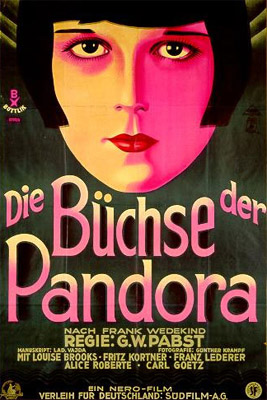
Pandora's Box is unquestionably my favorite film ever made. Nothing else even comes close. I have written before for
CineThreatOnline about this 1929 masterwork from the great G.W. Pabst, and I stand by my sentiments entirely.
Pandora's Box is one of those mystifying and enigmatic pictures. A monumental artistic achievement, and the Silent Era's last gasp of life. Pandora's Box is a character study of everyone in the film with the exception of it's main character Lulu. As a spectator, you are not supposed to wonder why Lulu does the things she does, but you are supposed to be greatly affected by them. Just like the other characters in the film, you are both obsessed and repulsed by what Louise Brooks as Lulu makes you feel. She makes you feel woozy, confused, and lost. She makes you fall in love. And she makes you bleed because of it.
No one could create Louise Brooks, just like no one could
create Pabst's 'Lulu'. No. Pabst's 'Lulu' had to be real, had to exist,
and had to do so naturally; unaware. No. Louise Brooks is not a Pabst
invention, and neither is her performance in Pandora's Box. What Pabst
did, quite simply, was find his 'Lulu'. The film itself is pure
invention, Pabst used psychology as his weapon and his intellect as his
charm. He pinned actors against each other, he favored one actor on
Monday only to dismiss him by Tuesday. Pabst created the purest form of
realism possible. By exposing his actor's insecurities, hiding the
plot from them, and initiating mind games with every member of the cast
on and off set. Pabst loved chess. His love of chess is evident in
Pandora's Box. Pandora's Box is his 'check-mate'.
So. No. Pabst did not create Lousie Brooks. Pabst made Lousie
Brooks what she is today; an ultimately tragic relic of a bygone age. I
cannot believe how astonishingly perfect Pandora's Box was conceived.
Pabst is a true nobleman of the cinema for a number of reasons, my
confidence will never sway in that regard. Pabst made the perfect film.
A rarity, a pleasure, and a true art. His direction, the key to the
enigma, only comes out of its perpetual hiding after a few viewings. It
is Louise Brooks, and only Louise Brooks, that your eyes and heart
feast on during the first time you watch Pandora's Box. Brooks was the
most enchanting, dazzling, and transcendental of the silent screen
goddesses. In the scene where Shon is caught making love to her by his
fiancé and his son, Brooks delivers the greatest facial expression ever
captured on film. An act of dominance and sexual achievement. A grin
that is truly timeless, as if she's staring through time and space,
testing your wildest urges, daring you to love her, and begging you to
beg to forget it. Although Brooks didn't know then, or even cared to
know at the time, soon she would have Pabst all figured out. She
realized that the greatest performance of her career, and one of the
most legendary in all of cinema, was not a performance at all, it
wasn't even acting. It was her. It was documentary. I was real.
Perhaps
the greatest invention belonging to G. W. Pabst was the invention of
truth. Things look different when they are being filmed, it is a
natural reaction to put on on an act of sort when one knows he or she
is being watched. Pabst bypassed that fault in cinematic realism and
created reality. Untouched by fabled hands, pure and innocent, L.
Brooks. Arguably, Pabst is the only director who has ever accomplished
such a remarkable feat.
Number Two:
If you want to be startled by a motion picture, if you want to be haunted by a performance, if you want to be humbled by sincerity -- Carl Theodor Dreyer's 1928 tale of The Passion Of Joan Of Arc is for you. What Dreyer accomplishes here is all thanks to his star, Maria Falconetti. Never has a role been executed to such an empathetic extent as Falconetti demonstrates here. You feel for her, more importantly,
you feel her.
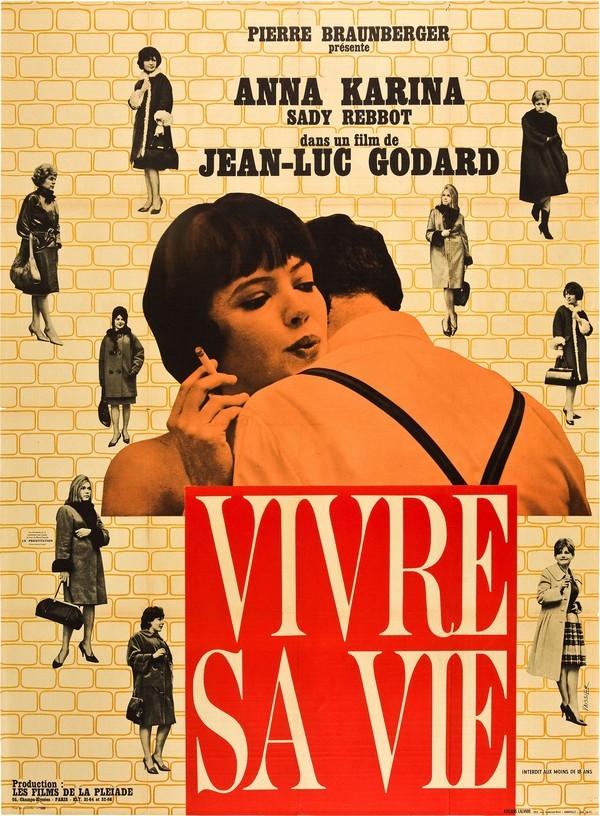
The Passion Of Joan Of Arc is haunting but it is never morbid nor is it depressing. In fact it is a lush example of filmmaking at its best, a director at his peak, and an actress in the role of a lifetime. The best scene Godard ever filmed was set in a movie theater. Godard filmed his actress, Anna Karina, watching The Passion of Joan Of Arc and becoming so deeply affected by it that she starts to weep. I weep almost every time I see Maria Falconetti. NO. Strike that. I weep almost every time Maria Falconetti
sees me.
Conrad Veidt should be a household name the way Chaplin, Garbo, and Fairbanks are household names. In The Man Who Laughs Veidt plays
Gwynplaine, a victim of a horrific act of torture and wickedness. He is the man with a permanent smile, disfigured as a child because he was the unfortunate son of a unwise father. As the title card states, the King condemned him "to laugh forever at his fool of a father."
Regarded as the most sparkling jewel of Universal Studios' silent canon, The Man Who Laughs was directed by the great Paul Leni, a key figure in German Expressionist cinema, and it is directed with the grace of a master. Leni tells it like a tragedy. Leni makes you never want to smile again, not unless you really mean it.
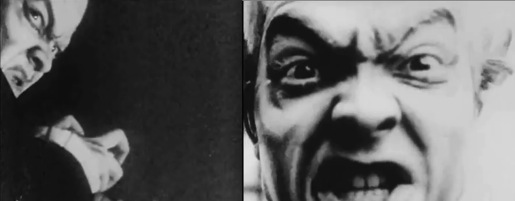
Conrad Veidt is a marvel in the film. He was born to play Gwynplaine the Smiling Clown, and I believe I was born to watch to him play it. But alas, Veidt was not Universal Mogul Carl Laemmle's first choice. Originally Lon Chaney was locked for the role, but wasn't too wowed my the material and bowed out. Lon Chaney made a splash in 1923 with another Victor Hugo screen adaptation, The Hunchback Of Notre Dame, and Chaney felt the material was far too similar for his liking. Nothing against the man of a thousand faces, but thank heavens Chaney dropped the ball! Veidt delivers one of the most harrowing and affecting performances ever seen. He is both horrifying and pitiful, a monster and a victim, a smile and a gasp. It is commonly known that Bob Kane drew inspiration for the legendary comic book villain the Joker from Veidt's appearance in the film. But I think he also took some of Veidt's manic hysteria with him as well. When you watch him on stage, you forget you're watching a movie altogether. Suddenly... suddenly you're watching an artist.
Number Four:
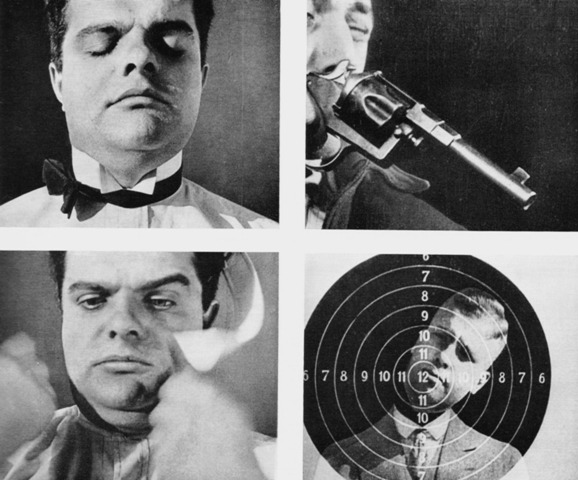
And make that two points for Conrad Veidt as we add another wonderful piece of German Expressionism on to the list! Actually, Robert Weine's 1920 film The Cabinet Of Dr. Caligari is
the expressionist film. Upon it's initial release the film was called vulgar, juvenile, and disgusting. Well, I have some good news for you...
it still is!
The Cabinet Of Dr. Caligari has an attitude problem. The film wants nothing more than to punch you right in the face. Visually extraordinary, stylistically legendary, and thematically revolutionary, The Cabinet Of Dr. Caligari is one of the best and one of the very first horror films ever produced. And the film is psychologically insane. Modern storytelling isn't nearly this good.
Robert Weine was an interesting figure in the history of film. Though he would never make something as triumphant as The Cabinet Of Dr. Caligari ever again, he would still have moments of genius periodically throughout his later career. Most notably with The Hands Of Orlac in 1924, another picture starring Conrad Veidt, and though it is incredibly slow paced, The Hands Of Orlac is ultimately satisfying and rewarding. But it's The Cabinet Of Dr. Caligari that I am here to appreciate. It is the performances of Werner Krauss and Conrad Veidt that I am here to remember and happily lull.
Visually, The Cabinet Of Dr. Caligari might be the most influential film ever made. I honestly doubt whether German Expressionism would have hit the western world the way that it did had it not been for Caligari. Metropolis certainly wouldn't have existed, Film Noir would not have developed in quite the same way, and modern filmmakers like Tim Burton and Guillermo Del Toro would be visionaries without a vision had it not been for Caligari.
It is an incredible film, and I highly recommend it. Modern psych-thrillers don't even come close to matching Caligari's complex and completely absorbing tale of murder, insanity, and possession. The dynamic of substance and style are equally matched throughout the film. Cheers, Weine, for a film that will live forever!
Number Five:
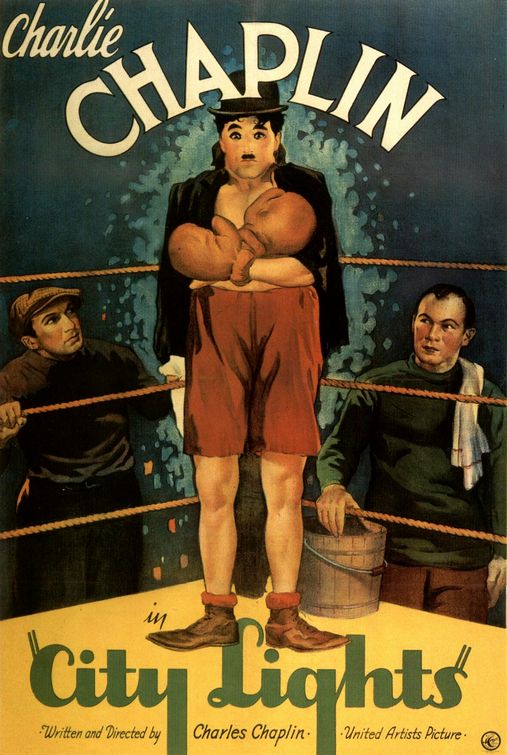
1931. City Lights. Chaplin's best work. Made during the heyday of talkies, City Lights is rebellious and courageous. It is the most heartfelt thing Chaplin ever produced. He proved that sound was not an improvement over silent films, but rather hindered the evolution of visual storytelling. He took what was already being called a dead technology and made something beautiful and extremely heartfelt with it. Words cannot describe the glory of City Lights, and that's something Chaplin wanted to make perfectly clear.
If only Silent Films had never died, and simply became a separate entity from Talkies, Film would have so much more beauty and love to them. What silent films accomplished in its short lifespan is more than modern filmmaking has done in almost one hundred years. Silent films evolved so far in such a short time that it's a crime against art that Talkies had to come along and tarnish such a fine legacy. Talkies haven't evolved worth a shit. In fact, if you follow the so-called evolution of the Talkie, you'll find that it's not an evolution at all, it's a downward progression, a devolution, and a fucking disgrace. The Silent Era is the one true era of cinema, it is Cinema unfiltered, it is Cinema 100 proof. It is my all-time favorite era of film, and it is a wonderful place to visit.
Be on the look-out for CineThreatOnline's web video where Zach Frances and a panel of film fanatics will be discussing Zach's favorite silent films, as well as the much-loved The Artist. Is The Artist a return to silent film, a love letter, or just an Academy Award Winning gimmick? Keep an eye out for the web video to see what CineThreatOnline thinks about it.